
Semplificare l'acquisto B2B: la piattaforma ideale per la fornitura di piastrelle

Semplificare l’acquisto B2B: la piattaforma ideale per la fornitura di piastrelle

Le piattaforme digitali dedicate al B2B si stanno affermando come strumenti strategici per semplificare l’acquisto di piastrelle a livello globale. L’obiettivo di una piattaforma digitale B2B non è soltanto facilitare l’incontro tra domanda e offerta, ma creare un ecosistema in grado di gestire ogni fase del processo: dalla selezione del prodotto fino alla logistica internazionale.

Il settore delle forniture di piastrelle a livello globale sta vivendo una fase di forte trasformazione. Se fino a pochi anni fa gli acquisti B2B si basavano su contatti diretti, fiere di settore e contrattazioni tradizionali, oggi la digitalizzazione sta rivoluzionando l’intero processo. Per i rivenditori, le imprese di costruzioni e gli architetti, la ricerca e l’acquisto di materiali non è più soltanto una questione di prezzo e qualità, ma anche di rapidità, affidabilità e trasparenza.

Questo articolo analizza come una piattaforma B2B ben strutturata possa rappresentare la soluzione ideale per le aziende che operano nel mercato delle piastrelle, illustrandone i vantaggi, le caratteristiche chiave e le prospettive future.

Il mercato globale delle piastrelle: sfide e opportunità

Il mercato mondiale delle piastrelle è altamente competitivo e frammentato. Secondo recenti stime, la produzione globale di piastrelle supera i 16 miliardi di metri quadrati all’anno, con Cina, India, Brasile, Italia e Spagna tra i principali player.

Le sfide principali che caratterizzano questo settore includono:

  • Diversità di offerta: i produttori propongono un’infinità di formati, finiture e soluzioni tecniche, rendendo complessa la comparazione.
  • Complessità logistica: spedire grandi quantità di materiale fragile in tutto il mondo richiede competenze e partner affidabili.
  • Differenze normative: standard di qualità e certificazioni variano da Paese a Paese.
  • Oscillazioni di prezzo: i costi di trasporto e le materie prime possono influenzare notevolmente il prezzo finale.

D’altra parte, le opportunità sono altrettanto significative: la crescita del settore delle costruzioni, il boom dell’edilizia residenziale e commerciale nei mercati emergenti e la spinta verso soluzioni sostenibili aprono spazi enormi per produttori e rivenditori.

Come TilesXport facilita il networking tra produttori e distributori di piastrelle

I limiti dei canali tradizionali di acquisto

Tradizionalmente, l’acquisto di piastrelle in ambito B2B avveniva tramite:

  • Agenti di commercio e distributori locali
  • Fiere internazionali come Cersaie (Italia) o Coverings (USA)
  • Contatti diretti tra produttore e acquirente

Questi metodi, seppur efficaci in passato, presentano oggi alcuni limiti:

  • Scarsa trasparenza sui prezzi: le trattative private non sempre garantiscono condizioni uniformi.
  • Processi lenti e complessi: dalla richiesta di cataloghi alla conferma d’ordine possono passare settimane.
  • Limitata comparazione dei prodotti: è difficile valutare rapidamente l’offerta di più fornitori.
  • Costi elevati di intermediazione: agenti e distributori spesso incidono in maniera significativa sul margine.

La conseguenza è che molte aziende rischiano di perdere competitività a causa di processi di approvvigionamento poco efficienti.

La piattaforma digitale B2B come soluzione strategica

Una piattaforma digitale dedicata all’acquisto B2B di piastrelle si propone di risolvere queste inefficienze, diventando un punto di riferimento unico per i professionisti del settore.

Caratteristiche principali di una piattaforma B2B ideale:

  1. Catalogo globale centralizzato
    • Accesso a migliaia di prodotti da produttori di tutto il mondo.
    • Ricerca avanzata per formato, colore, finitura, certificazioni e destinazione d’uso.
  2. Trasparenza e comparazione
    • Prezzi chiari e aggiornati.
    • Possibilità di confrontare diversi fornitori su parametri standardizzati.
  3. Gestione ordini e logistica integrata
    • Preventivi automatici per costi di trasporto e tempi di consegna.
    • Collaborazione con spedizionieri internazionali specializzati.
  4. Pagamenti sicuri e garantiti
    • Sistemi di escrow o assicurazione delle transazioni per ridurre il rischio finanziario.
  5. Supporto normativo e certificazioni
    • Accesso immediato a documentazione tecnica e conformità agli standard locali.
  6. Piattaforma multilingua e multi-valuta
    • Per semplificare le relazioni in un contesto realmente globale.
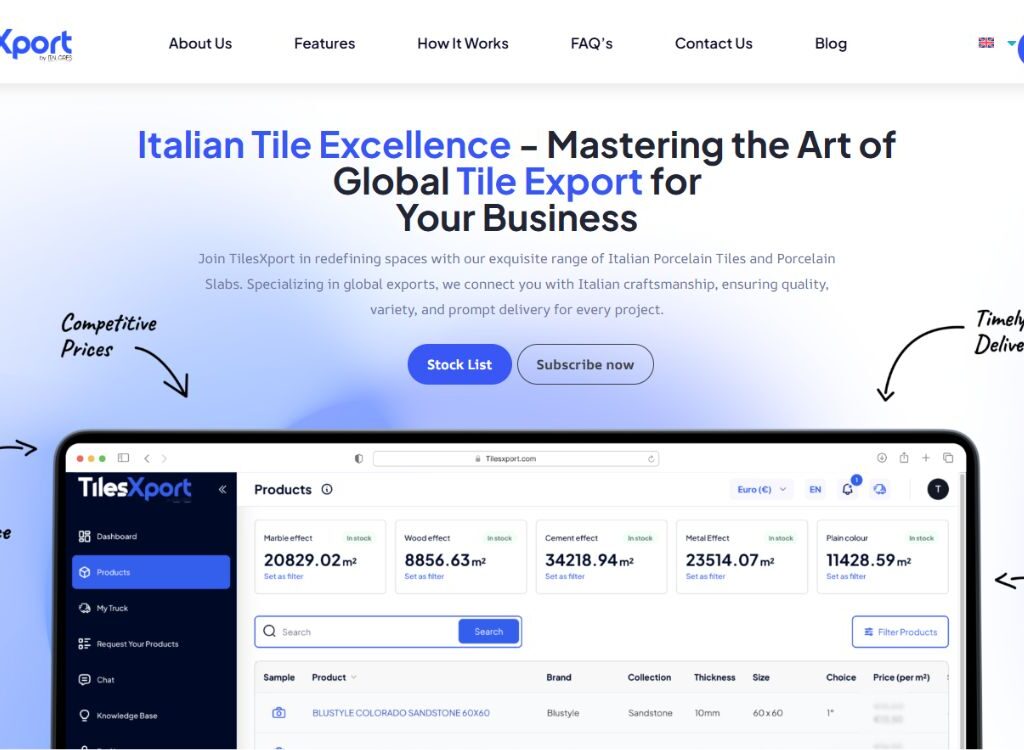
Perché TilesXport è il futuro del mercato B2B delle piastrelle

Vantaggi per acquirenti e fornitori

Per gli acquirenti (rivenditori, imprese di costruzione, architetti):

  • Risparmio di tempo: processi digitali più rapidi rispetto a negoziazioni tradizionali.
  • Riduzione dei costi: eliminazione di intermediari superflui.
  • Ampia scelta: possibilità di accedere a fornitori globali senza limiti geografici.
  • Maggiore sicurezza: grazie a sistemi di pagamento protetti e valutazioni dei fornitori.

Per i fornitori (produttori e distributori di piastrelle):

  • Visibilità internazionale: accesso a nuovi mercati senza investimenti eccessivi.
  • Riduzione dei costi commerciali: minore dipendenza da fiere e agenti.
  • Gestione semplificata: cataloghi digitali, tracciamento ordini e assistenza clienti integrati.
  • Feedback immediato: recensioni e dati analitici sull’andamento delle vendite.

Tecnologia e innovazione: il cuore della piattaforma B2B

Oltre alla semplice funzione di marketplace, una piattaforma ideale deve integrare soluzioni tecnologiche avanzate:

  • Intelligenza Artificiale (AI) per suggerire prodotti alternativi o complementari, ottimizzando l’esperienza di acquisto.
  • Blockchain per garantire la tracciabilità delle forniture e la trasparenza delle transazioni.
  • Realtà aumentata (AR) per visualizzare le piastrelle direttamente in un ambiente simulato.
  • Big Data Analytics per analizzare tendenze di mercato e comportamenti d’acquisto.

L’integrazione di queste tecnologie consente non solo di migliorare l’efficienza, ma anche di creare un vantaggio competitivo duraturo.

Logistica e Supply Chain: l’anello cruciale di una piattaforma B2B

Uno degli aspetti più complessi nell’approvvigionamento internazionale di piastrelle è la logistica. Una piattaforma B2B efficace deve semplificare anche questo aspetto, fornendo:

  • Calcolo immediato dei costi di spedizione in base a destinazione, quantità e modalità di trasporto.
  • Assicurazione sulle spedizioni contro danni e ritardi.
  • Tracciamento in tempo reale dello stato della consegna.
  • Gestione delle dogane e delle pratiche burocratiche.

In questo modo, l’acquirente può concentrarsi sul proprio core business senza doversi occupare delle complessità del trasporto internazionale.

Come individuare i partner giusti per esportare gres porcellanato

La sostenibilità come vantaggio competitivo

Sempre più aziende scelgono fornitori in base a criteri di sostenibilità. Una piattaforma B2B moderna deve valorizzare i produttori che adottano pratiche eco-friendly:

  • Piastrelle realizzate con materiali riciclati.
  • Processi produttivi a basso consumo energetico.
  • Certificazioni ambientali come LEED o ISO 14001.

Integrare filtri di ricerca basati sulla sostenibilità può diventare un elemento distintivo e attrattivo per una clientela sempre più attenta.

Casi d’uso e applicazioni reali

  • Un’impresa di costruzioni cinese può acquistare direttamente piastrelle da un produttore italiano, riducendo i costi e ricevendo supporto logistico integrato.
  • Un rivenditore nordamericano può ampliare la propria gamma di prodotti importando piastrelle artigianali mediterranee con garanzia di conformità normativa.
  • Un architetto in Medio Oriente può accedere a collezioni esclusive italiane, confrontando prezzi e certificazioni in tempo reale.

Questi esempi mostrano come la piattaforma non sia solo un marketplace, ma un vero e proprio strumento di internazionalizzazione.

Conclusioni

Il settore delle piastrelle, per la sua complessità e dimensione internazionale, è uno dei candidati ideali per beneficiare di una piattaforma B2B dedicata. Un sistema digitale che centralizza prodotti, prezzi, logistica e certificazioni rappresenta un punto di svolta per acquirenti e fornitori, garantendo efficienza, trasparenza e competitività.

La piattaforma ideale non è soltanto un luogo di scambio commerciale, ma un ecosistema completo che integra tecnologia, logistica e sostenibilità. In un mondo sempre più connesso, chi saprà sfruttare queste soluzioni sarà in grado di posizionarsi come leader globale, semplificando l’acquisto e la distribuzione di piastrelle con un approccio moderno, sicuro e orientato al futuro.

Logistica e spedizioni internazionali: ottimizzare i costi e i tempi per l'export di piastrelle

Logistics and International Shipping: Optimizing Costs and Times for Tile Exports

Logistics and international shipping are crucial elements in an increasingly globalized world. Logistics refers to the management of the flow of goods between the point of origin and the point of consumption to meet customer needs. International shipping, on the other hand, concerns the transport of goods across national borders, involving various means of transport such as ships, airplanes, and trucks.

The complexity of international logistics requires careful planning and coordination. It is necessary to consider variables such as customs, international regulations, and supply chain management. Every step must be optimized to reduce costs and improve efficiency.

For tile exporters, understanding these processes is fundamental. Tiles, being fragile materials, require extremely careful handling to avoid damage during transport. Choosing the right logistics partners and implementing advanced technologies can make a difference in ensuring that tiles arrive at their destination in perfect condition.

The importance of logistics for tile export

Tile export is a competitive sector that requires impeccable logistics to ensure customer satisfaction. A well-organized logistics system can significantly reduce operational costs, improve delivery times, and increase end-customer satisfaction. Logistics is not just a cost to manage, but an opportunity to differentiate yourself from the competition.

Tiles must be transported with care to avoid damage, and this requires adequate packaging and secure transport. An error in logistics management can lead to delays, additional costs, and customer dissatisfaction, factors that can negatively affect your brand’s reputation.

Furthermore, efficient logistics allow you to respond quickly to market demands. In a sector where trends can change rapidly, being able to adapt and deliver quickly is essential to maintaining competitiveness and customer satisfaction.

Main factors influencing shipping costs

Shipping costs are influenced by several factors that must be carefully analyzed to optimize expenses. Among the main elements to consider are:

  • Distance and mode of transport. The distance between the point of origin and the final destination can significantly affect costs. Furthermore, the choice between sea, air, or land transport influences costs and delivery times.
  • Volume and weight of goods. The size and weight of the tiles affect shipping costs. It is necessary to optimize packaging to reduce unnecessary space and weight.
  • Customs duties and regulations. Tariffs imposed by destination countries and customs regulations can add significant costs. In-depth knowledge of international laws is crucial to avoid unexpected expenses.

Analyzing these factors and finding solutions to optimize them can result in significant cost savings. Collaborating with industry experts can help you navigate through logistical complexities and find the most efficient path for your shipments.

Strategies for optimizing shipping times

Optimizing shipping times is essential to maintain competitiveness in the global market. One of the most effective strategies is the adoption of an integrated supply chain management system. This system allows for more accurate planning, real-time monitoring of shipments, and better resource management.

Another key strategy is collaborating with reliable logistics partners who offer customized solutions for your business. These partners can help you identify the fastest transport routes and avoid delays due to customs or transport issues.

Finally, the use of advanced technologies, such as GPS tracking and logistics information management systems, can significantly improve shipping efficiency. These technologies provide real-time data, allowing you to make informed decisions and react quickly to any problems.

Best practices for managing tile logistics

Managing tile logistics requires a detailed and organized approach. Here are some of the best practices to implement:

  1. Adequate packaging. Using high-quality packaging materials to protect tiles during transport is fundamental. Packaging must be designed to absorb shocks and prevent damage.
  2. Advance planning. Planning all phases of the shipment in advance, from production to transport, reduces the risk of unforeseen events and delays.
  3. Continuous monitoring. Implement monitoring systems that allow you to track shipments in real-time, ensuring that every stage of the process is under control.

These practices not only protect your goods but also improve operational efficiency and customer satisfaction. Adopting a proactive approach to logistics management can make a difference in the success of your export operations.

Innovative technologies in logistics and international shipping

Innovative technologies are revolutionizing the world of logistics and international shipping. Among these, artificial intelligence and machine learning systems offer new opportunities to improve efficiency and reduce costs. These technologies can analyze large amounts of data to optimize transport routes and predict delivery times with greater precision.

Furthermore, blockchain is emerging as a powerful solution to improve the transparency and security of international transactions. Blockchain allows tracking every stage of the shipment, ensuring data integrity and reducing the risk of fraud.

Finally, drones and autonomous vehicles are becoming increasingly common in the logistics sector. These technologies offer new ways to deliver goods to hard-to-reach areas, reducing delivery times and improving accessibility.

How to choose the right partner for logistics and international shipping

Choosing the right logistics partner is a critical decision that can significantly impact the success of your export operations. It is important to evaluate several factors before making a decision:

  • Industry experience. A partner with specific experience in tile export will have a better understanding of your needs and the challenges of the sector.
  • Technological capabilities. Ensure that the partner uses the latest technologies for logistics management, such as advanced tracking systems and supply chain management platforms.
  • Reputation and reliability. Research reviews and references to assess the partner’s reputation. A reliable partner will be able to keep delivery promises and quickly resolve any issues.

Making an informed choice can ensure that your shipments are managed efficiently and that your tiles arrive at their destination in perfect condition.

Conclusion: the future of logistics and international shipping for the tile sector

The future of logistics and international shipping in the tile sector promises significant innovations and changes. With the adoption of advanced technologies, companies can expect greater efficiency, reduced costs, and faster delivery times. Automation and artificial intelligence will continue to play a crucial role, offering new opportunities to improve logistics processes.

Furthermore, sustainability is becoming an increasingly important aspect. Companies are looking for ways to reduce the environmental impact of their logistics operations by adopting more eco-friendly practices and using less polluting means of transport.

To remain competitive, it is essential that companies in the tile sector invest in training and development for their staff, ensuring they are updated on the latest trends and technologies. Get ready for a future of changes and opportunities in the world of logistics and international shipping.


Don’t miss the opportunity to optimize your logistics and improve your export operations. Discover how we can help you implement the best strategies and technologies for your business. Contact us today for a personalized consultation and start transforming your logistics into a competitive advantage!

Design e qualità italiana: le piastrelle che tutti desiderano

Italian design and quality: the tiles that everyone desires

When talking about Italian design and quality, it’s inevitable to think of the excellence and refinement that characterize Made in Italy products. Porcelain stoneware tiles represent one of the sectors where Italy shines for innovation and style. These materials, appreciated globally, are synonymous with durability and refined aesthetics.

In Italy, the tile sector has a long history of artisanal tradition and technological innovation. Italian companies are recognized for their ability to combine cutting-edge design with advanced production techniques, offering products that are not only practical but also visually stunning. This balance between beauty and functionality is what makes Italian porcelain stoneware tiles unique and desirable.

Italian quality is not limited only to external beauty. It also includes a commitment to the environment and sustainability. Many Italian companies, in fact, adopt eco-compatible production processes, using natural and recycled raw materials, and reducing environmental impact. This approach not only enhances the final product but also the territory and the community from which these materials originate.

Italian Design and Quality: Porcelain Stoneware Tiles

Porcelain stoneware is an extremely versatile and resistant ceramic material, made through a process of pressing and firing at high temperatures. This procedure gives the material superior compactness and resistance, making it ideal for a wide range of applications. Its ability to imitate other materials, such as wood, marble, or natural stone, without compromising on durability, makes it particularly appreciated.

  • Resistance to wear, moisture, and stains. Making it a perfect option for high-traffic environments, such as kitchens and bathrooms, as well as commercial spaces. Its non-porous surface does not absorb liquids, reducing the risk of permanent stains and making cleaning simple and fast.
  • Excellent aesthetic qualities. Thanks to modern technologies, companies can produce tiles that surprisingly replicate the appearance of natural materials, while integrating unique colors and textures. This allows designers to create personalized and innovative spaces, that reflect the latest design trends without sacrificing functionality.

Advantages of Porcelain Stoneware Tiles

Porcelain stoneware tiles offer numerous advantages that go beyond simple aesthetics.

  • Longevity. Unlike other materials, these tiles maintain their original appearance for many years, resisting scratches, abrasions, and chemical agents. This durability makes them a smart investment for those looking for long-term solutions.
  • Versatility. Thanks to advanced digital printing techniques, porcelain stoneware tiles can accurately replicate a wide range of materials, allowing for endless design possibilities. Whether it’s a rustic, modern, or classic look, it is possible to find a tile that meets every stylistic need.
  • Ecological choice. Many Italian manufacturers are committed to reducing the environmental impact of their products, using sustainable raw materials and eco-friendly production processes. This commitment not only protects the environment but also ensures that the tiles are safe for domestic and commercial use, without harmful emissions.

Current Trends in Porcelain Stoneware Tile Design

In the world of design, trends change constantly, and porcelain stoneware tiles are no exception. Currently, one of the most popular trends is the use of large formats. These larger tiles offer a more homogeneous and continuous appearance, reducing the number of grout lines and creating a wider and more luxurious visual effect.

Projects with Italian tiles

Another dominant trend is the natural effect. More and more people are choosing tiles that imitate the appearance of natural materials like wood, marble, and stone. These tiles not only offer the desired aesthetics but also all the practical advantages of porcelain stoneware, making them a perfect choice for those seeking beauty and functionality.

Finally, customization has become a keyword in interior design. Thanks to the wide availability of textures and formats, it is possible to create unique and distinctive environments. Whether it’s combinations of materials, colors, or shapes, the options are practically endless, allowing every space to be customized according to one’s own style.

Why Choose Italian Porcelain Stoneware Tiles?

Opting for Made in Italy porcelain stoneware tiles means choosing a solution that combines design and quality. These tiles offer excellent wear resistance and are ideal for high-traffic environments, ensuring an impeccable appearance even after years of use. Their ability to resist stains and moisture makes them perfect for kitchens and bathrooms, where hygiene is essential.

Beyond quality, porcelain stoneware tiles also offer incredible design variety. From natural textures to modern patterns, you can choose from a wide range of styles to create an environment that reflects your personality and taste. This design flexibility allows you to customize every space, creating a unique and welcoming atmosphere.

Finally, porcelain stoneware tiles are a sustainable choice. In addition to eco-sustainable production processes and its long lifespan, porcelain stoneware is fully recyclable at the end of its life.

Applications of Porcelain Stoneware: From Floors to Walls

Porcelain stoneware is incredibly versatile and can be used in a variety of applications, both residential and commercial.

  • Flooring. One of the most common uses is for floors, where its resistance and ease of maintenance make it an excellent choice. Whether it’s a living room, a kitchen, or a commercial space, these tiles provide a durable and beautiful surface.
  • Walls. Its waterproof properties make it ideal for bathrooms and kitchens, where moisture can be an issue. Furthermore, thanks to the wide range of available colors and textures, it’s possible to create stunning visual effects, transforming a simple wall into a distinctive design element.
  • Decorative Elements. Thin porcelain stoneware slabs can be used to cover fireplaces, columns, kitchen countertops, tables, furniture, etc.
  • Terraces, Gardens, and Facades. Its ability to withstand weather agents and extreme climatic conditions makes porcelain stoneware an ideal choice for outdoor spaces, ensuring an elegant and long-lasting appearance over time. This versatility makes it an indispensable material for those seeking flexible and high-quality solutions.

Inspiring Projects with Porcelain Stoneware Tiles: Homes and Commercial Spaces

Porcelain stoneware tiles offer endless creative possibilities, both for residential interior design and for commercial projects.

In a home, these tiles can transform a simple bathroom into a luxury spa, with marble or wood effects that create a relaxing and sophisticated atmosphere. In kitchens, they can add a touch of modernity and functionality, with easy-to-clean surfaces capable of resisting stains.

ABK Ceramics

As for commercial spaces, porcelain stoneware is an excellent choice for shops, restaurants, and offices. Its durability makes it ideal for high-traffic areas, while the variety of available designs allows for the creation of unique and captivating environments. For example, a restaurant can use stone-effect tiles to create a rustic and welcoming atmosphere, while a fashion store might opt for glossy and modern finishes for an elegant and contemporary look.

Italian Tile Export

Exploring inspiring projects can provide ideas and stimuli for your space. Take a look at the latest trends and let yourself be inspired by the innovative solutions that porcelain stoneware can offer.

Conclusion: The Future of Italian Design and Quality in Porcelain Stoneware

The future of Italian design and quality in the porcelain stoneware sector looks bright and promising. With continuous innovation in production technologies and growing attention to sustainability, Italian companies are well-positioned to continue leading the global tile market. The commitment to excellence and respect for the environment will remain central to this sector, offering high-quality solutions that meet modern needs.

For those seeking materials that combine aesthetics and functionality, porcelain stoneware tiles represent an unbeatable choice. They will continue to be a benchmark for those wishing to create elegant and durable spaces, reflecting the true spirit of Made in Italy. The ability to innovate and adapt to new trends will be fundamental to maintaining design leadership.

Perché il gres porcellanato è la scelta preferita per l’export?

Why is porcelain stoneware the preferred choice for export?

In recent years, porcelain stoneware has gained a prominent position in the global market, becoming one of the most sought-after materials for flooring and wall coverings. Its popularity in exports is constantly growing, thanks to a unique combination of technical and aesthetic characteristics that make porcelain stoneware ideal for various applications, from residential construction to large commercial projects.

In this article, we will explore the reasons for this success, analyzing the advantages that porcelain stoneware offers in terms of durability, versatility, design, and sustainability, and how these factors contribute to its affirmation in international markets.

What is Porcelain Stoneware and its Main Characteristics

Porcelain stoneware is a highly resistant and versatile ceramic material, primarily used in construction and interior design. This type of tile is composed of a mixture of clays, feldspars, and other materials, subjected to a sintering process at high temperatures. This process gives porcelain stoneware unique characteristics, making it an excellent choice for many building applications.

The main characteristics of porcelain stoneware include:

  • Compressive Strength. It can withstand heavy loads, making it ideal for floors and surfaces subject to intense traffic.
  • Impermeability. Porcelain stoneware is virtually waterproof, which makes it suitable for humid environments like bathrooms and kitchens.
  • Low Porosity. Thanks to its dense structure, it does not absorb stains and dirt, facilitating maintenance and cleaning.

These properties make porcelain stoneware not only aesthetically pleasing but also practical and durable over time. In a context of growing attention to the quality of materials used in construction, porcelain stoneware is positioned as a preferred option for both industry professionals and end consumers.

The big names in porcelain stoneware: the companies dominating the market

The Advantages of Porcelain Stoneware Slabs in Modern Construction

The adoption of porcelain stoneware in modern construction is continuously growing, thanks to a series of advantages it offers compared to other materials. One of the main benefits is its versatility. It can be used in a variety of applications, from floors to wall coverings, both indoors and outdoors. Furthermore, porcelain stoneware can mimic other surfaces, such as wood or stone, offering an elegant appearance without compromising functionality.

Another significant advantage is its resistance to atmospheric agents and wear. In outdoor environments, porcelain stoneware is weather-resistant and does not fade with sun exposure. This makes it ideal for verandas, terraces, and other outdoor areas. Additionally, its resistance to stains and scratches means that surfaces remain beautiful and intact for a long time, reducing maintenance costs.

Finally, porcelain stoneware is an ecological material. Its production can be carried out using sustainable techniques and, once used, it can be recycled. This aspect is particularly important in an era where sustainability is central to consumer purchasing choices. Choosing porcelain stoneware contributes to creating greener and more sustainable buildings.

Projects featuring Italian tiles

The Italian Porcelain Stoneware Industry: A Globally Recognized Excellence

Italy is known worldwide for its excellence in the production of porcelain stoneware. This reputation is based on a combination of innovation, design, and artisanal tradition. Italian companies are at the forefront of the sector, constantly investing in research and development to improve the quality and variety of their products.

Porcelain stoneware production in Italy is characterized by a wide range of styles and finishes. Whether it’s glossy, matte tiles, or effects that mimic natural materials, the options are virtually endless. This variety allows designers and architects to use porcelain stoneware in creative ways, adapting to the specific needs of each project.

Furthermore, the Italian porcelain stoneware sector is constantly growing, with many companies expanding their production capacity to meet international demand. The high quality of materials and the ability to innovate have made the Italian industry a global benchmark in the porcelain stoneware market.

Why Italian Porcelain Stoneware is So Sought After Abroad

Italian porcelain stoneware has gained a considerable reputation abroad, thanks to a combination of quality and design. Italian tiles not only meet high standards of resistance and durability, but they also offer an unparalleled aesthetic. This is particularly attractive to foreign markets, where consumers look for products that combine functionality and beauty.

Another factor contributing to the demand for Italian porcelain stoneware is the ability of companies to customize products based on specific customer needs. The possibility of choosing from a wide range of colors, finishes, and sizes allows customers to get exactly what they want, making Italian porcelain stoneware a preferred choice in many international projects.

Moreover, the strong commitment of the Italian industry to sustainability has made porcelain stoneware an increasingly interesting option for foreign markets. With growing environmental awareness, consumers are more inclined to choose materials that respect the environment. Italian companies are responding to this demand with sustainable production practices and recyclable materials.

Advantages of using Italian tiles in international construction projects

Main Export Markets for Italian Porcelain Stoneware

The export of Italian porcelain stoneware extends to numerous international markets, each with its own peculiarities and preferences. Among the main export markets are:

  1. United States. This market is characterized by a growing demand for high-quality products and design. Italian porcelain stoneware is highly appreciated for its sophisticated finishes and wide variety of styles.
  2. Germany. With a strong tradition in construction and design, Germany is a key market for Italian porcelain stoneware. German architects and designers often look for products that combine aesthetics and functionality.
  3. United Kingdom. The demand for porcelain stoneware is growing in the UK, particularly for renovation and interior design projects. British consumers appreciate innovative solutions and high-quality materials.
  4. Asian Markets. Countries like China and Japan are showing increasing interest in Italian porcelain stoneware, attracted by the aesthetics and quality of the products.
  5. Middle Eastern Countries. Here, porcelain stoneware is used in prestigious projects, such as hotels and shopping centers, where maximum quality and design are sought.

These markets represent significant opportunities for Italian companies, which can expand their global presence and reach new customer segments.

Design Trends Driving International Demand

The demand for porcelain stoneware is influenced by several design trends emerging globally. One of the main trends is the use of natural materials. Consumers are increasingly attracted to products that mimic the beauty of wood, marble, and other natural materials, without their disadvantages. In this context, porcelain stoneware offers perfect solutions, combining aesthetics and functionality.

Furthermore, minimalism continues to dominate design choices. Clean surfaces and neutral colors are in high demand, as they create bright and airy environments. Porcelain stoneware lends itself well to this trend, with a wide range of options that can adapt to any furnishing style.

Finally, sustainability is becoming a determining factor in purchasing decisions. Consumers are increasingly interested in materials that are not only beautiful and durable but also produced responsibly. Italian companies are responding to this need by adopting ecological production practices and developing recyclable products.

Export of Made in Italy tiles: how B2B companies are expanding the global market

Sustainability and Porcelain Stoneware: A Winning Combination for Export

Sustainability has become a central theme in the construction and design sector, and Italian porcelain stoneware stands out as an eco-friendly material. Its production can occur with reduced resource use and without harmful chemicals, making it an ideal choice for those seeking sustainable building solutions.

Italian companies are investing in innovative technologies that reduce environmental impact during the production process. For example, many use low-emission production plants and renewable energy sources. These efforts not only contribute to environmental protection but also enhance the companies’ image internationally.

Furthermore, porcelain stoneware is a highly recyclable material. At the end of its life cycle, it can be reused in various ways, helping to reduce waste. This aspect is particularly appreciated by consumers and designers, who seek materials that are not only beautiful and durable but also responsible.

Challenges and Opportunities in Exporting Porcelain Stoneware

Although the export of Italian porcelain stoneware presents numerous opportunities, there are also challenges to face. One of the main challenges is international competition. Many countries are increasing their production of porcelain stoneware, trying to compete with Italy in terms of quality and price. Italian companies must therefore continue to innovate and differentiate their products to maintain their leadership position in the market.

Another challenge is represented by local regulations and standards in foreign markets. Each country has its own laws regarding building materials, and Italian companies must be prepared to adapt to these rules to export their products.

However, there are also many opportunities:

  • The growing demand for sustainable and high-quality materials in international markets offers fertile ground for Italian companies.
  • Furthermore, the ability to customize products according to specific customer needs represents a significant competitive advantage.
  • Companies that can seize these opportunities will be able to expand their presence in foreign markets and increase their sales.

Marketing Strategies to Promote Italian Stoneware Abroad

To address the challenges and seize the opportunities offered by porcelain stoneware export, it is essential to adopt effective marketing strategies. Here are some of the main strategies that can be implemented:

  1. Branding. Creating a strong and recognizable brand is essential to differentiate from the competition. Companies must clearly communicate the quality and design of their products, focusing on the tradition and excellence of “Made in Italy”.
  2. Digital Marketing. Using social media, websites, and e-commerce platforms is crucial to reach a global audience. Companies can use targeted campaigns to attract customers in specific markets, showcasing the features and applications of porcelain stoneware.
  3. Participation in Fairs and Events. Participating in international industry fairs is an excellent way to present products and establish contacts with potential customers and distributors. These events also offer the opportunity to stay updated on the latest market trends.
  4. Collaborations with Designers and Architects. Establishing partnerships with design professionals can help promote porcelain stoneware in prestigious projects. Collaborating with well-known designers can increase brand visibility and generate interest in new markets.

The Future of Porcelain Stoneware Export: Forecasts and Prospects

Looking to the future, the export of Italian porcelain stoneware seems destined to grow. The demand for high-quality and sustainable materials will continue to increase, and porcelain stoneware is well-positioned to meet these needs. Companies that can anticipate market trends and adapt quickly to changes will have greater chances of success.

Furthermore, technological innovation will play a key role in the future of the sector. New production and design technologies will allow the creation of even more advanced and personalized products, expanding the possibilities for using porcelain stoneware.

Finally, growing environmental awareness and pressure for greater sustainability in the construction sector will continue to influence consumer choices. Italian companies, already committed to sustainable practices, will be advantaged in this context, allowing them to attract customers increasingly attentive to the environmental impact of their choices.

In conclusion, Italian porcelain stoneware is not only a high-quality material but also represents a sustainable and versatile option for the future of export. Investing in this sector can lead to significant growth and success opportunities.

Il mercato globale delle piastrelle: come le statistiche svelano il successo del Made in Italy

The Global Tile Market: How Statistics Reveal the Success of Made in Italy

The Global Tile Market represents a dynamic and constantly evolving sector. With the increasing demand for high-quality materials for construction and renovation, tiles have become a fundamental element in space design. In this context, “Made in Italy” emerges as a mark of excellence, synonymous with style, quality, and innovation. This article will explore various aspects of the global tile market, highlighting the contribution of the Italian industry and the reasons for its success.

Overview of the Global Tile Market

The Global Tile Market is vast and complex. In 2021, the market value was estimated to exceed $250 billion, with forecasts of continued growth in the coming years. Several regions, including Asia-Pacific, Europe, and America, play a crucial role in this landscape.

  • Growth Factors. Increasing urbanization, population growth, and economic expansion in many emerging nations are all factors stimulating tile demand.
  • Market Segmentation. The market is divided into ceramic tiles, porcelain stoneware tiles, and natural stone tiles. Each of these segments has unique characteristics and meets different market needs.
  • Design Trends. Consumers are increasingly drawn to innovative and sustainable designs, prompting manufacturers to invest in research and development.

In this context, Made in Italy stands out for its ability to combine tradition and innovation. Italian manufacturers are known for their attention to detail and the use of artisanal techniques that add value to their products.

The Impact of Made in Italy on the Global Tile Market

Made in Italy is a brand that conveys trust and quality. In the tile sector, this is particularly evident. Italian companies have established themselves as leaders thanks to distinctive designs and high-quality materials. But what are the reasons for this success?

  • Design and Innovation. Italian design is appreciated worldwide. Italian companies not only create aesthetically pleasing products but also invest in innovative technologies that optimize production and improve tile performance.
  • Sustainability. More and more consumers are looking for eco-sustainable products. Italian companies have adopted sustainable practices, reducing the environmental impact of production and offering tiles made from recycled materials.
  • Distribution Network. Widespread presence in international markets has allowed Italian manufacturers to establish themselves in various countries. The export of Italian tiles has seen constant growth, contributing significantly to the national economy.

In summary, Made in Italy is not just a label, but a commitment to excellence, innovation, and sustainability. This is why Italian tiles continue to conquer the global market.

Ragno Ceramiche

Key Statistics on the Italian Tile Global Market

Here are some key data points highlighting the impact of Italian tiles on the global market:

  • Production. In 2023, the production of ceramic tiles in Italy was approximately 373.7 million square meters.
  • Companies. In Italy, there are 125 active companies in ceramic tile production, employing approximately 18,432 direct workers.
  • Exports. In 2023, the export of Italian tiles reached €5 billion.
  • Innovation. Approximately 70% of Italian companies in the sector invest in research and development, demonstrating a strong commitment to continuous innovation.

These statistics demonstrate not only the sector’s resilience but also the ability of Italian companies to adapt to changing market demands. The combination of artisanal tradition and technological innovation makes them a key player in the Global Tile Market.

Factors Driving the Success of Italian Tiles Abroad

Several factors contribute to the success of Italian tiles in foreign markets. Understanding these elements is crucial for predicting future industry trends.

  • Quality and Reliability. Italian tiles are synonymous with quality. Thanks to rigorous production standards and selected materials, consumers feel confident investing in Made in Italy products.
  • Aesthetics and Design. Italian design is sought after worldwide. Italian companies manage to combine functionality and aesthetics, creating products that not only meet practical needs but also integrate perfectly into any environment.
  • Marketing and Branding. Italian companies have successfully built a strong brand image, associated with luxury and prestige. Using effective marketing strategies, they have managed to position themselves in high-value market niches.

These factors not only strengthen the presence of Italian tiles abroad but also contribute to building lasting business relationships and ensuring continuous growth.

ABK Ceramiche
ABK Ceramiche

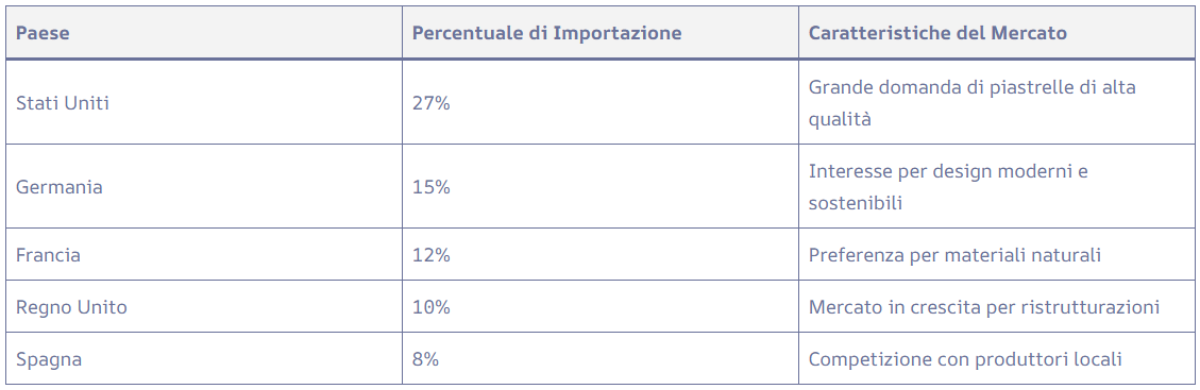
Main Importing Countries of Italian Tiles

The global landscape of Italian tile trade is diverse and presents various opportunities. The main importing countries include:

Main importing countries of Italian tiles

Each country presents unique opportunities and challenges. For example, in the United States, the tile market is influenced by contemporary design trends, while in Germany, there is a strong emphasis on sustainability. Being aware of these dynamics allows you to better guide your strategies for approaching foreign markets.

Technological Innovations in the Italian Tile Sector

In the tile sector, technological innovation plays a crucial role. Italian companies are adapting to these new technologies to remain competitive and meet the demands of an evolving market.

Advanced Technologies

  • Digital Printing. Digital printing allows for the creation of personalized and detailed designs, increasing their aesthetic appeal. This technology offers unprecedented flexibility, enabling manufacturers to quickly respond to market trends.
  • Sustainable Materials. The use of recycled and sustainable materials is becoming increasingly common. Italian companies are investing in research for new materials that reduce environmental impact without compromising quality.
  • Automated Production. Automation of production processes not only increases efficiency but also reduces costs. This allows Italian companies to maintain competitive tile prices while upholding high-quality standards.

Innovation is not just a matter of technology, but also of strategic approach. Companies must continue to invest in research and development to keep pace with global trends and consumer expectations.

Winning Strategies for Tile Export: How to Conquer the Global Market

Challenges and Opportunities for the Italian Tile Industry

Despite its success, the Italian tile industry faces several challenges. However, these challenges can also turn into growth opportunities.

Challenges

  1. Global Competition. Italian companies face competition from producers in low-cost countries. This puts pressure on prices and the need for continuous innovation.
  2. Regulatory Changes. Environmental regulations are becoming increasingly strict. Companies must adapt quickly to these new rules to avoid penalties and ensure sustainability.
  3. Market Trends. Changes in consumer preferences can influence demand. It is crucial to monitor these trends and adapt accordingly.

Opportunities

  1. Expansion into Emerging Markets. Developing countries represent a significant opportunity for Italian tile exports, where demand for high-quality materials is growing.
  2. Sustainability. Investing in sustainable practices not only helps comply with regulations but can also attract an increasingly conscious market segment.
  3. Digitalization. The digitalization of sales and marketing processes offers opportunities to reach new customers and markets more effectively.

In conclusion, despite the challenges, the Italian tile industry has many opportunities to thrive globally.

Future Forecasts for the Global Tile Market and Made in Italy

Looking ahead, forecasts for the Global Tile Market are optimistic. Several emerging trends could influence the sector in the coming years.

  1. Demand Growth. Tile demand is expected to continue growing, driven by factors like urbanization and the renovation of existing spaces. This represents an opportunity for Italian companies to expand their market share.
  2. Focus on Sustainability. Sustainability will be a central theme. Companies adopting ecological practices will have a competitive advantage. Investments in research and development of sustainable materials will be crucial.
  3. Innovation and Digitalization. Companies will need to continue innovating and digitalizing their processes to remain competitive. The ability to respond quickly to market needs will be crucial.

In summary, the Global Tile Market offers a landscape rich in opportunities. With the right mix of innovation, sustainability, and effective marketing, Made in Italy can continue to thrive and dominate the world tile market.

Projects featuring Italian tiles

Conclusion

The success of the Global Tile Market is a complex phenomenon involving various factors, from product quality to technological innovation. Made in Italy stands out for its ability to adapt and respond to consumer needs. Investing in these areas is essential for continued growth in a competitive environment.

If you are an entrepreneur in the tile sector or a design enthusiast, now is the time to explore the opportunities the market offers. Don’t miss the chance to be part of this evolution. Start planning your strategy for the future and discover how Made in Italy can make a difference in your business.

Come TilesXport facilita il networking tra produttori e distributori di piastrelle

How TilesXport Facilitates Networking Between Tile Manufacturers and Distributors

TilesXport is an innovative platform specifically designed to facilitate networking between tile manufacturers and distributors. Its mission is clear: to create an ecosystem where professionals in the tile industry can connect, collaborate, and grow together. In an increasingly global and competitive market, TilesXport aims to break down traditional barriers, making the interaction process between manufacturers and distributors smoother and more accessible.

The platform offers a dynamic environment where users can discover new products, evaluate collaboration opportunities, and optimize their distribution strategies. TilesXport is committed to supporting companies in navigating market challenges, providing tools and resources that facilitate communication and cooperation. In this context, networking becomes a crucial element for success in the tile industry.

Ultimately, TilesXport is not just a networking platform; it is a catalyst for innovation and growth for manufacturers and distributors. Its mission goes beyond simple connection, aiming to build lasting and profitable relationships that can contribute to the prosperity of all parties involved.

The advantages of networking between manufacturers and distributors

Networking between manufacturers and distributors offers numerous advantages, essential for success in the tile industry.

  • Greater visibility of market offerings. Manufacturers can present their products to a wider audience, while distributors can easily discover new business opportunities. This exchange of information is fundamental to staying competitive and up-to-date on industry trends.
  • Facilitates the creation of strategic relationships. Collaborating with other industry professionals allows for the sharing of resources, experiences, and knowledge. These partnerships can lead to synergies that foster innovation and operational efficiency. For example, a manufacturer might collaborate with a distributor to develop a custom product that meets the specific needs of a local market.
  • Offers the opportunity to learn from best practices. Participating in networking events and interacting with other industry professionals allows for gathering valuable information on how to address common challenges. This knowledge sharing is fundamental for continuous improvement and sustainable growth of companies in the tile sector.

How TilesXport connects tile manufacturers and distributors

TilesXport uses a series of advanced tools and features to facilitate the connection between manufacturers and distributors. Through an intuitive interface, users can create detailed company profiles that highlight their offerings and expertise. This allows distributors to easily find manufacturers that best suit their specific needs and vice versa.

Furthermore, the platform offers advanced search functionalities. Users can filter their searches based on various criteria, such as product type, geographical region, or technical specifications. This makes finding business partners much simpler and faster, allowing manufacturers and distributors to focus on the most relevant opportunities.

Finally, TilesXport includes integrated communication tools, such as chat and direct messaging. These tools allow users to get real-time assistance, facilitating negotiation and deal-making. In this way, the platform not only connects manufacturers and distributors but also promotes effective and collaborative communication.

Why TilesXport is the future of the B2B tile market

Key features of the TilesXport platform

TilesXport is equipped with several key features that make it an indispensable tool for tile manufacturers and distributors. Here are some of the main characteristics that distinguish the platform:

  • Wide selection of products. TilesXport offers a vast range of porcelain stoneware tiles in different styles, designs, and formats to meet diverse furnishing needs.
  • Easy and intuitive search. The platform allows searching for products easily and intuitively, using filters for tile type, color, size, finish, and more.
  • Detailed product information. Detailed information is available for each product, including high-resolution images, technical descriptions, product sheets, and certifications.
  • Order management. The platform simplifies order management, allowing professionals to monitor order status, delivery times, and shipping information.

These features not only simplify the networking process but also contribute to creating a collaborative and productive work environment for all actors involved. Discover all the features of TilesXport.

The impact of TilesXport on the global tile market

TilesXport has a significant impact on the global tile market, helping to transform the way manufacturers and distributors interact with each other. The platform facilitates access to markets previously considered difficult to penetrate, allowing local manufacturers to expand their reach internationally. This is particularly advantageous for small and medium-sized manufacturers, who can now compete with larger operators.

Furthermore, TilesXport promotes innovation in the sector. Through networking, manufacturers can collaborate with distributors to develop unique products that meet specific needs. This type of collaboration is essential to remain relevant in a constantly evolving market, where consumer tastes and preferences change rapidly.

Finally, operational efficiency is another key advantage. The platform allows distributors to optimize their purchasing and inventory management strategies, reducing costs and improving profitability. This competitive advantage is crucial in a sector where margins can be thin and competition is fierce.

How to sign up and start using TilesXport

Signing up for TilesXport is a simple and straightforward process. Follow these steps to start using the platform:

  1. Create an account. Go to the TilesXport registration page.
  2. Fill out the registration form. Enter the required information, such as company name, sector, and contact details. Make sure to provide accurate and detailed information.
  3. Verify your account. After completing the registration, you will receive a confirmation email. Click on the link provided to activate your account.
  4. Complete your profile. Once the account is activated, log in to the platform and start creating your company profile. Add information about your products and services, and upload high-quality images.
  5. Start connecting. After completing your profile, start exploring the platform.
TilesXport account registration

TilesXport also offers support and resources to guide you through the process of using the platform, ensuring you can make the most of all its features.

Future trends in networking between tile manufacturers and distributors

Networking between tile manufacturers and distributors is evolving rapidly, and there are several emerging trends that could influence the sector in the coming years. First of all, the adoption of digital technologies will continue to grow. Platforms like TilesXport are becoming indispensable tools for companies looking to remain competitive in an increasingly digital market.

Secondly, there will be a greater emphasis on sustainability. Consumers and businesses are becoming increasingly aware of the environmental impact of their purchases. Tile manufacturers who adopt sustainable practices and offer eco-friendly products will likely be advantaged in networking with distributors who share similar values.

Finally, global networking is becoming increasingly important. As companies seek to expand their reach beyond national borders, platforms like TilesXport will provide opportunities to connect with partners worldwide. This will not only open new avenues for growth but also contribute to a more diverse and innovative business environment.

Conclusion: TilesXport as a catalyst for growth in the tile industry

In conclusion, TilesXport represents a significant innovation in the tile industry. The platform not only facilitates networking between manufacturers and distributors but also creates an environment conducive to collaboration and innovation. Through its advanced features and commitment to user support, TilesXport is helping to shape the future of the sector.

If you are a tile manufacturer or distributor, don’t miss the opportunity to join this dynamic network. Start exploring the potential of TilesXport for your business today.

If you want to discover more about how TilesXport can help you grow, register!

Il mercato delle piastrelle negli Stati Uniti: opportunità e strategie di export

The US Tile Market: Export Opportunities and Strategies

The tile market in the United States presents a landscape rich with opportunities for companies wishing to expand their business. The sector is constantly growing, thanks to factors such as urbanization, increased demand for home renovations, and evolving design trends. With a population constantly seeking new aesthetic and functional solutions, your company has the opportunity to enter a dynamic and expanding market. This article will explore the various export opportunities available, the challenges you might face, and effective strategies for succeeding in the US market.

Overview of the Tile Market in the United States

In the United States, the tile market is vast and diverse, comprising a range of materials spanning from ceramic to porcelain stoneware, glass to natural stone. According to the latest research, the value of the US tile market has reached a significant level, with continued growth projected in the coming years. This development is attributable to various factors, including:

  • the increase in spending on construction and renovation;
  • the interest in sustainable materials;
  • preferences for versatile aesthetic solutions.

Tiles are widely used in various sectors, including residential, commercial, and industrial. Each segment has its own needs and preferences, making it essential for you to understand the specifics of each market. For example, in the residential sector, consumers are increasingly attracted to unique and personalized designs, while in the commercial sector, durability and functionality are priorities.

In this context, it is also crucial to consider regional dynamics. American states feature various architectural styles and design trends, influencing the choice of tiles. For example, coastal areas might prefer moisture-resistant materials, while colder regions might require tiles that offer thermal insulation. Understanding these variables will allow you to adapt your offering and position yourself more effectively in the market.

Current Trends in the US Tile Sector

The tile sector in the United States is currently influenced by numerous emerging trends. One of the most significant is the growing demand for eco-friendly materials. Consumers are increasingly aware of the environmental impact of their choices and seek products that not only meet their aesthetic needs but are also sustainable. This represents an opportunity for you to stand out in the market by offering tiles made from recycled or low-impact materials.

Another important trend is the use of advanced technologies in tile design and production. Innovations such as digital printing on tiles allow for the creation of complex and personalized designs that capture consumers’ attention. The adoption of smart technologies in tiles, such as integrated lighting or anti-slip features, is gaining popularity, especially in the residential sector. Investing in these technologies could offer you a significant competitive advantage.

Finally, minimalist design and the use of neutral colors continue to dominate style preferences. People seek environments that reflect peace and simplicity, making tiles in muted tones and with matte finishes highly sought after. Being able to offer collections that align with these trends will be crucial for your success in the market.

5 mistakes to avoid when exporting tiles

Export Opportunities for Italian Companies

The US market represents one of the largest export opportunities for Italian companies in the tile sector. Italy’s reputation for quality and innovative design is well-established, and American consumers are willing to invest in products that offer added value. One of the keys to success will be your approach to product presentation, emphasizing the craftsmanship and distinctive design that characterize Italian tiles.

Furthermore, diversifying your product portfolio can open additional doors. Offering a range of tiles that meet different market needs, such as those for commercial, residential, or public spaces, will allow you to attract a wider audience. Also consider the possibility of collaborating with US architects and designers, as their influence can help you better position your products.

Finally, don’t forget the importance of participating in industry trade shows and events. These events offer the opportunity to connect directly with potential customers and business partners, as well as provide a platform to showcase your products. The Coverings event, for example, is one of the most renowned trade shows in the United States for the tile industry and can be an excellent starting point.

International porcelain stoneware fairs: an opportunity to expand your business

Challenges and Barriers to Entry in the US Market

Entering the US market is not without challenges. Regulations and certifications required can pose a significant barrier for foreign companies. Each state has its own laws and regulations regarding material quality, business practices, and environmental standards. It is crucial that you conduct thorough research to understand these regulations and ensure compliance.

Another challenge concerns fierce competition. The market is saturated with local and international manufacturers, meaning you will need to develop a unique value proposition to stand out. This requires in-depth market analysis and effective marketing strategies that allow you to capture consumer attention.

Finally, cultural differences and consumer preferences can be an obstacle. Americans may have different tastes and expectations compared to European consumers, so it is essential for you to adapt your marketing and communication strategies to resonate with the local audience. Collaborating with local marketing experts and advertising agencies can be an advantageous approach.

Effective Marketing Strategies for Italian Tiles in the USA

To succeed in the US market, it is imperative to develop targeted and effective marketing strategies. One of the first things to consider is creating a robust online presence. A professional and well-designed website, along with a strong social media presence, can help you build brand awareness and reach a wider audience. Use captivating visual content and brand stories to attract consumer attention.

Additionally, consider adopting a personalized approach in your advertising campaigns. Using market data and analytics tools to segment your audience can lead to more effective campaigns. For example, if you identify a market segment particularly interested in sustainable tiles, you can develop specific content and offers for that audience.

Finally, strategic partnerships with local designers and architects can serve as leverage to increase your visibility. Collaborating on residential or commercial design projects can not only help you gain credibility but also showcase your products in a real-world context, facilitating consumer purchasing decisions.

Distribution and Sales Channels for Tiles in the United States

Choosing distribution channels is crucial for the success of your export strategy. In the United States, you have several options available, each with its own advantages and disadvantages. Retailers specializing in tiles and building materials are a popular choice, as they can provide direct access to end consumers. However, also consider online retailers, which are gaining popularity due to the convenience they offer customers.

An online sales platform can be a powerful tool to grow your tile business in the USA. TilesXport is a reliable and comprehensive online platform that allows you to manage your tile procurement in the United States automatically and easily.

Why TilesXport is the future of the B2B tile market

Technological Innovations and Design in the Tile Sector

The tile sector is constantly evolving, thanks to technological innovation and new design trends. Advanced technologies not only improve material quality but also the customer experience. For example, the use of radiant heating tiles is gaining popularity, offering comfortable and efficient solutions for heating spaces.

Furthermore, innovation in tile design allows for the creation of unique solutions that adapt to modern lifestyles. Modular and customizable tiles are becoming increasingly sought after, enabling consumers to express their individuality through decor. Investing in research and development of new designs can help you maintain a competitive edge.

Finally, do not underestimate the importance of smart tiles. These products integrate technologies such as humidity sensors, temperature control, and even home automation features. With the increasing demand for smart home solutions, the introduction of smart tiles could represent a significant opportunity for your company.

Conclusion

The tile market in the United States offers unprecedented opportunities for Italian companies, but it requires careful preparation and well-planned strategies. From understanding industry trends to adopting innovative technologies, every aspect of the export process must be considered carefully. With an effective marketing strategy and the use of platforms like TilesXport, you can position your company for success in this competitive market.

If you are ready to discover how Italian tiles can conquer the US market, start exploring your export options today! Don’t miss the opportunity to grow your business and bring Italian design into the heart of American homes. Contact our team for a personalized consultation on exporting tiles to the United States and find out how we can help you achieve success in the American market.

Servizi B2B dedicati: ottimizziamo la tua catena di approvvigionamento di gres porcellanto

Dedicated B2B Services: We optimize your supply chain

In the competitive porcelain tile industry, optimizing your supply chain is essential to maintaining a competitive edge. Our dedicated B2B services are designed to help you achieve this goal, offering tailored solutions to improve efficiency, reduce costs, and increase your competitiveness in the market.

Whether you are a distributor or retailer of porcelain tiles, our experience and expertise will help you optimize every stage of your supply chain, from order planning to logistics and distribution. Through personalized advice and the implementation of best practices, we will guide you towards a leaner, more flexible, and profitable supply chain.

Benefits of optimizing the supply chain

Optimizing the porcelain tile supply chain can lead to numerous benefits for your business:

  • Cost reduction. Through an in-depth analysis of your processes and the implementation of optimization strategies, you can reduce storage, transport, and distribution costs.
  • Improved efficiency. An optimized supply chain will allow you to increase productivity, reduce delivery times, and respond more quickly to fluctuations in demand.
  • Increased competitiveness. Thanks to lower costs and greater efficiency, you will be able to offer more competitive prices and improve your position in the market.
  • Greater visibility and control. With better visibility at every stage of the supply chain, you can make more informed decisions and respond more quickly to changes.
  • Improved customer satisfaction. An optimized supply chain will allow you to provide a more reliable service and better meet the needs of your customers.

Dedicated B2B services: how to optimize your porcelain tile supply chain

Optimizing the porcelain tile supply chain is essential to ensuring maximum efficiency and competitiveness in the sector. Let’s see how our dedicated B2B services can make a difference:

Dedicated B2B services: strategies to optimize the supply chain

To optimize your porcelain tile supply chain, it is important to adopt a holistic strategy that involves all stages of the process. Here are some key strategies to consider:

  1. Supply and demand planning. Use demand forecasting and production analysis tools to align your supply capacity with market needs, thereby reducing storage costs and waste.
  2. Supply management. Develop solid relationships with key suppliers and implement supply management practices, such as just-in-time purchasing and stock reduction.
  3. Logistics optimization. Analyze your transport routes, shipping methods, and distribution processes to identify opportunities for improvement in terms of costs, delivery times, and sustainability.
  4. Digitalization and automation. Leverage digital technologies, such as enterprise resource planning (ERP) and supply chain management (SCM), to automate processes, improve visibility, and make more informed decisions.
  5. Collaboration with supply chain partners. Create strategic partnerships with suppliers, distributors, and other supply chain stakeholders to share information, align objectives, and optimize workflows.
  6. Continuous improvement. Regularly monitor the performance of your supply chain, identify areas for improvement, and implement corrective actions to increase efficiency and profitability.

These strategies, tailored to your specific needs, will help you build a more resilient and competitive porcelain tile supply chain.

5 errori da evitare nell'export di piastrelle

Creating a plan for optimizing the supply chain

To achieve tangible results from the optimization of your porcelain tile supply chain, it is essential to develop a detailed action plan. Here are the key steps to follow:

  1. Assessment of the current situation. Analyze your supply chain in detail, identifying strengths, weaknesses, opportunities, and threats.
  2. Definition of objectives. Set clear and measurable objectives, such as cost reduction, improvement of delivery times, or increased flexibility.
  3. Development of strategies and actions. Based on the assessment and objectives, develop specific strategies and actions to optimize each stage of the supply chain.
  4. Planning of implementation. Create a detailed plan for the implementation of your strategies, including timelines, necessary resources, and those responsible for each activity.
  5. Monitoring and continuous improvement. Implement monitoring systems to regularly evaluate results and make the necessary changes to achieve the set goals.

Involve all stakeholders, such as the purchasing team, logistics, and management, to ensure alignment and success of your supply chain optimization plan.

Tips for optimizing the porcelain tile supply chain

Here are some additional tips for optimizing your porcelain tile supply chain:

  • Diversification of suppliers. Maintain a diversified supplier base to reduce the risk of supply disruption and increase your bargaining power.
  • Adoption of innovative technologies. Invest in advanced technology solutions, such as the Internet of Things (IoT), artificial intelligence, and blockchain, to improve visibility and efficiency in your supply chain.
  • Training and development of personnel. Invest in training and skill development of your team so they can adopt best practices in supply chain management.
  • Sustainability and social responsibility. Incorporating sustainability and social responsibility principles into your supply chain can improve your brand image and customer satisfaction.
  • Flexibility and agility. Develop the ability to adapt quickly to market changes and fluctuations in demand so you can seize new opportunities.

By following these tips, you can build a more efficient, resilient porcelain tile supply chain that is able to respond to the constantly evolving needs of the market.

Export gres porcellanato

Our dedicated B2B services for optimizing the porcelain tile supply chain

Our B2B services are designed to help you achieve your goals for optimizing the porcelain tile supply chain.

Thanks to our experience and expertise, we will help you build a more efficient, flexible, and profitable porcelain tile supply chain.

Find out what we can do for you!

Conclusions

Optimizing the porcelain tile supply chain is essential to maintaining a competitive edge in a constantly evolving market. Through our dedicated B2B services, we will help you identify and implement the most effective strategies to reduce costs, improve efficiency, and increase your competitiveness.

Contact us now to find out how our dedicated B2B services can help optimize your porcelain tile supply chain. Our team of experts will be happy to discuss your specific needs and propose personalized solutions for your business.

B2B delle piastrelle: un'analisi approfondita sul futuro del settore

B2B Tiles: An In-Depth Analysis of the Future of the Industry

The tile sector is undergoing a period of rapid change, driven by technological evolution and evolving market needs. In particular, the B2B (Business-to-Business) segment is facing unique challenges and opportunities that will shape its future significantly. In this article, we will explore the trends, innovations, and strategies that will define the next chapter of B2B in tiles.

Current trends in the tile sector for B2B

The B2B tile market is undergoing a significant transformation. Some of the main trends that are shaping the sector include:

  • Digitalization. The adoption of digital technologies is revolutionizing the way companies interact with customers, manage processes, and make strategic decisions.
  • Personalization. B2B customers require tailored solutions that meet their specific needs, pushing manufacturers to offer greater flexibility and customization.
  • Sustainability. Growing environmental awareness is driving demand for more eco-friendly products and processes, with a focus on reducing the carbon footprint and the circular economy.
  • Internationalization. Companies in the sector are expanding their geographical horizons, exploring new markets, and establishing global partnerships to increase their competitiveness.
  • Innovation in materials. Technological evolution is leading to the development of new materials and advanced solutions, such as high-performance tiles with smart features.

Understanding these key trends will help you position your company for future success in B2B for tiles.

Export di piastrelle Italgres: un’esperienza di shopping virtuale personalizzata per le aziende con TilesXport

The impact of technology on the tile sector

Technology is revolutionizing the way companies in the tile sector operate and interact with B2B customers. Some of the main technological innovations that are transforming the sector include:

  • Process automation. The adoption of automation technologies, such as robotics and artificial intelligence, is improving production efficiency and reducing delivery times.
  • Digital platforms. E-commerce solutions, online configurators, and order management systems are simplifying interactions between manufacturers and B2B customers.
  • Data analysis. The use of advanced data analysis allows companies to make more informed decisions, optimize processes, and anticipate customer needs.
  • Augmented and virtual reality. These technologies are improving the shopping experience of B2B customers, allowing them to view and customize tiles interactively.
  • Blockchain. The adoption of blockchain is improving the traceability and transparency of the supply chain, helping to strengthen trust and collaboration among stakeholders.

By leveraging these technological innovations, tile companies can increase their efficiency, improve the customer experience, and gain a competitive advantage in the B2B market.

New opportunities and challenges

The future of B2B for tiles presents a range of new opportunities, but also several challenges to face. Here are some of the main ones:

Opportunities

  • Large-scale personalization. The ability to offer tailor-made solutions to B2B customers, leveraging flexible production technologies and digital customization.
  • Global expansion. Access to new international markets and the opportunity to establish strategic partnerships on a global level.
  • Sustainability as a competitive advantage. The growing demand for environmentally friendly products and processes represents an opportunity for companies able to meet these needs.
  • Value-added services. Offering complementary services, such as technical consulting, training, and after-sales assistance, can increase the value perceived by B2B customers.

Challenges

  • Adaptation to digitalization. The need to invest in digital technologies and develop the skills needed to make the best use of them.
  • Managing the complexity of the supply chain. The increase in globalization and personalization requires more effective management of the supply chain.
  • Differentiation of the value proposition. The need to offer a unique and compelling value proposition in an increasingly competitive market.
  • Attraction and retention of talent. The ability to attract and retain qualified professionals in a highly competitive labor market.

By successfully addressing these opportunities and challenges, tile companies can position themselves for success in the future of B2B.

Come individuare i partner giusti per esportare gres porcellanato

Innovations in the tile production process

The tile production process for the B2B market is undergoing a profound transformation thanks to technological innovations. Some of the main innovations include:

  • Advanced automation. The use of robots, artificial vision systems, and artificial intelligence technologies to automate and optimize production phases, reducing errors and increasing productivity.
  • Innovative production processes. The development of more energy-efficient ovens and firing techniques, reducing the environmental impact of production.
  • Advanced materials. The use of new materials, such as high-performance ceramics, smart tiles, and eco-sustainable solutions, to offer innovative features and characteristics.
  • Quality monitoring and control. The integration of sensors and real-time monitoring systems to ensure product quality and quickly identify any problems.

These innovations in the production process will allow tile companies to increase efficiency, reduce costs, and offer more customized and high-quality solutions to B2B customers.

The importance of sustainability in the tile sector for B2B

Sustainability is becoming a key factor in the B2B tile market, with increasing demand for environmentally friendly products and processes. Companies that succeed in integrating sustainable practices into their business can obtain numerous advantages:

  • Regulatory compliance. Compliance with environmental regulations and sustainability directives is becoming increasingly crucial for operating in the market.
  • Competitive advantage. Offering sustainable solutions can differentiate your company from competitors and attract environmentally conscious B2B customers.
  • Cost reduction. The adoption of more energy-efficient technologies and processes and resource consumption can lead to significant long-term savings.
  • Brand reputation and image. Commitment to sustainability can improve the perception of your brand and strengthen the trust of B2B customers.
  • Innovation and new opportunities. Sustainability can stimulate product and process innovation, opening the way to new market opportunities.

To integrate sustainability into your business model, you will need to adopt practices such as reducing emissions, using recycled materials, managing waste efficiently, and optimizing the supply chain. Investing in sustainability will help you meet the expectations of B2B customers and position your company as a leader in the sector.

The evolution of distribution channels in B2B for tiles

Distribution channels in the B2B tile market are undergoing a profound transformation, driven by the adoption of digital technologies and the evolving needs of customers. Some of the main trends in this area include:

  • E-commerce platforms. The emergence of B2B e-commerce platforms, which allow tile manufacturers to reach and serve customers more directly and conveniently.
  • Supply chain integration. Closer collaboration between manufacturers, distributors, and retailers to optimize the supply chain and improve visibility and efficiency.
  • Advanced logistics. The adoption of more efficient logistics solutions, such as just-in-time delivery and intelligent inventory management, to reduce delivery times and costs.
  • Multichannel sales channels. Offering an omnichannel shopping experience, combining personal contact with digital tools for greater convenience and personalization.
  • Value-added services. The integration of complementary services, such as technical consulting, training, and after-sales assistance, to increase the value perceived by B2B customers.

By adapting your distribution channels to these trends, you can improve accessibility, efficiency, and the quality of service offered to B2B customers, strengthening your competitive position.

Inbound Marketing nel settore Ceramico: come attrarre e convertire clienti B2B

Marketing strategies in the future of B2B for tiles

To succeed in the future of B2B for tiles, companies will need to adopt innovative and targeted marketing strategies. Here are some of the main strategies to consider:

  1. Advanced digital marketing. Using tools such as search engine optimization (SEO), social media marketing, and online advertising to reach and engage B2B customers more effectively.
  2. Personalization and segmentation. The ability to personalize messages, products, and services according to the specific needs of different B2B customer segments.
  3. Valuable content. Creating and sharing informative and valuable content, such as technical guides, webinars, and case studies, to position yourself as an expert in the sector.
  4. Loyalty programs. Offering incentives, exclusive services, and loyalty programs to build long-term relationships with B2B customers.
  5. Strategic collaborations. Developing partnerships with influencers, designers, and other key players in the sector to broaden the reach and credibility of your brand.

By integrating these innovative marketing strategies into your approach, you can attract, engage, and retain B2B customers, positioning your company as a leader in the sector.

Design trends in the tile sector for B2B

The design of tiles for the B2B market is evolving rapidly, driven by customer preferences and technological innovations. Here are some of the main design trends to watch out for:

  • Personalization and customization. The demand for tailor-made solutions, with the possibility of customizing shapes, sizes, colors, and finishes.
  • Innovative materials and textures. The use of new materials, such as advanced ceramics, smart tiles, and eco-sustainable solutions, to offer unique and distinctive features.
  • Minimalist and contemporary aesthetics. The preference for simple, clean, and modern designs, which adapt to different architectural and interior design styles.
  • Integrated features. The integration of additional features, such as antibacterial properties, self-cleaning capabilities, and anti-slip characteristics, to meet specific needs.
  • Sustainability and respect for the environment. The growing demand for design solutions that reflect a commitment to sustainability and attention to environmental impact.

By keeping pace with these design trends, you can offer B2B customers innovative and attractive solutions that stand out from the competition and respond to their constantly evolving needs.

Conclusions on the future of B2B for tiles

The future of B2B for tiles looks full of challenges and opportunities. Companies in the sector will have to deal with technological evolution, increased global competition, and the evolving needs of customers. However, those who can adapt and innovate will be able to seize the advantages offered by this transforming landscape.

Investing in new technologies, promoting sustainability, offering customized solutions, and improving the customer experience will be essential for future success. Furthermore, the adoption of innovative marketing strategies and the alignment of design trends with the preferences of the B2B market will allow companies to stand out from the competition.

5 errori da evitare nell'export di piastrelle

5 Mistakes to Avoid in Tile Exports

Exporting tiles represents a great opportunity for companies in the ceramic sector to expand their business and reach new markets. However, the export process can be complex and full of pitfalls. In this article, we will explore the 5 most common mistakes that companies need to avoid to succeed in exporting tiles.

Common mistakes in tile exporting

Exporting tiles is a complex activity that requires careful planning and in-depth knowledge of the international market. By avoiding the most common mistakes and following best practices, you can increase your chances of success and consolidate your presence in foreign markets. Here are some of the most common mistakes:

1. Mistakes in researching new markets

One of the first crucial steps for a company entering tile exporting is identifying the most promising markets. Unfortunately, many businesses make mistakes at this stage:

  1. Lack of in-depth market analysis. Skipping or undervaluing the analysis of market data, trends, competition, and consumer preferences can lead to wrong choices about target countries.
  2. Focusing only on large markets. Although countries with the largest import volumes may seem the most appealing, do not underestimate the opportunities offered by emerging or niche markets, which could be more accessible and profitable.
  3. Lack of flexibility and adaptation. Markets change rapidly, so it is essential to constantly monitor the evolution of customer needs and preferences to adapt your offering promptly.
  4. Too generic approach. Trying to serve all market segments in the same way rarely works. It is important to define a clear positioning and develop tailor-made strategies for different targets.

To avoid these errors, we recommend that you dedicate time and resources to in-depth market analysis, carefully evaluate opportunities even in lesser-known countries, and maintain a flexible and adaptable approach to the specific needs of each market.

2. Mistakes in managing logistics in tile exporting

Logistics is a crucial aspect of tile exporting, but many companies underestimate its complexity:

  1. Underestimation of transport and shipping costs. Transporting tiles, especially over long distances, can involve high costs for fuel, customs duties, and insurance. Ignoring these factors can undermine the profitability of exporting.
  2. Lack of planning and coordination of the supply chain. Poor management of delivery times, stocks, and communication with logistics partners can cause delays, damage to products, and customer dissatisfaction.
  3. Little attention to packaging and product protection. Tiles are delicate goods and require proper packaging to prevent breakage and damage during transport. Underestimating this aspect can lead to additional costs and claims.
  4. Insufficient monitoring and tracking of shipments. Without an effective tracking system, it becomes difficult to manage any problems and provide updated information to customers.

To successfully deal with the logistics of exporting tiles, it is essential to accurately assess costs, carefully plan the supply chain, invest in quality packaging, and implement monitoring and tracking systems for shipments.

I segreti del packaging vincente per il gres porcellanato

3. Mistakes in choosing commercial partners

The selection of commercial partners, such as distributors, agents, or local representatives, is essential for the success of tile exporting. However, many companies make mistakes at this stage:

  1. Choosing unreliable partners or partners not aligned with your strategy. Distributing your products through unqualified channels or those not in line with your brand image can compromise your reputation and market penetration.
  2. Lack of due diligence and in-depth assessment of potential partners. Before entering into agreements, it is essential to carefully verify the financial soundness, experience, network of contacts, and reputation of your partners.
  3. Inadequate contracts and commercial agreements. A poorly defined definition of responsibilities, payment terms, and sales conditions can lead to conflicts and problems in managing the relationship.
  4. Poor involvement and support for partners. Without adequate training, assistance, and involvement, your partners may not be able to effectively promote and sell your products.

To avoid these errors, dedicate time and resources to the careful selection of partners, verify their reliability and alignment with your strategy, and maintain a relationship of active collaboration and continuous support.

Export gres porcellanato

4. Mistakes in communication and marketing in tile exporting

Communication and marketing play a crucial role in tile exporting, but many companies make mistakes in this area:

  1. Lack of adaptation of messages and strategies to target markets. Using the same communication and marketing approaches used in the domestic market rarely works abroad. It is essential to understand the needs, preferences, and habits of local consumers.
  2. Inadequate presentation of products. A poorly worded description or an unattractive presentation of your products can make them difficult to market abroad.
  3. Poor promotion on the right channels. Ignoring the most effective communication and sales channels in target markets, such as trade fairs, e-commerce platforms, influencers, or targeted campaigns, can limit your visibility.
  4. Lack of follow-up and after-sales assistance. Without adequate assistance and complaint management, you could compromise the satisfaction and loyalty of international customers.

To avoid these errors, invest in a thorough understanding of foreign markets, adapt your messages and marketing strategies, carefully curate the presentation of your products, and leverage the most effective communication and sales channels. Also, make sure to provide excellent after-sales service.

5. Poor knowledge of regulations and customs procedures

Each market has its own laws, regulations, and standards to comply with for importing tiles. For example, many countries require specific certifications for importing tiles. Not having them can lead to delays or the blocking of goods.

In addition, difficulties may arise in managing customs procedures. Customs regulations are complex and vary from country to country. Errors in filling out documentation can cause delays and additional costs.

Other factors to consider

  • Exchange rates. Fluctuations in exchange rates can affect the competitiveness of your products.
  • Trade barriers. Some countries apply duties or quotas to tile imports.
  • Economic and political crises. Unforeseen events can affect supply and demand.

Conclusions

Exporting tiles represents a great opportunity for companies in the ceramic sector, but it requires a careful and informed approach to avoid costly mistakes. By focusing on market research, logistics management, partner selection, and adequate communication/marketing, you can maximize your chances of success in international markets.